

Your trailer plug is a critical part of any towing setup. It is one of the electrical connections between your vehicle and your trailer, powering everything from lights to brakes and accessories. For safety, legality, and reliability, it is essential that the plug is correctly wired and suited to your towing setup.
Just as important as good wiring is choosing the right type of trailer plug. In this guide, we break down the differences between 7-pin and 12-pin trailer plugs to help you choose the best option for your towing needs.
At Speedy Towbars, our standard towbar installation includes a 7-pin plug. If your setup requires more functionality, we can upgrade this to a 12-pin plug and configure it to suit your trailer or caravan.
What Is a Trailer Plug?
A trailer plug transfers electrical signals from your vehicle to your trailer. These signals operate essential functions such as tail lights, brake lights, indicators, and, in some cases, electric brakes and auxiliary power for accessories.
The type of trailer you tow and how you use it will determine whether a 7-pin or 12-pin plug is required. Smaller trailers typically only need lighting to be legal, which is fully covered by a 7-pin plug. Electric brakes can also be supported through a 7-pin setup when an electric brake controller is fitted separately.
As trailers increase in size and capability, additional power circuits are often needed. This includes power for fridges, battery charging, emergency breakaway brake systems, and more. This is where a 12-pin plug may be required.
What Is a 7 Pin Trailer Plug?
A 7-pin flat plug is the most common and widely used trailer plug. It is suitable for the majority of standard towing applications.
A typical 7-pin setup powers:
• Tail and marker lights
• Brake lights
• Indicators
• And in some cases, a reverse or auxiliary circuit
• Electric brakes can also operate through a 7-pin plug, provided an electric brake controller is installed and wired separately.
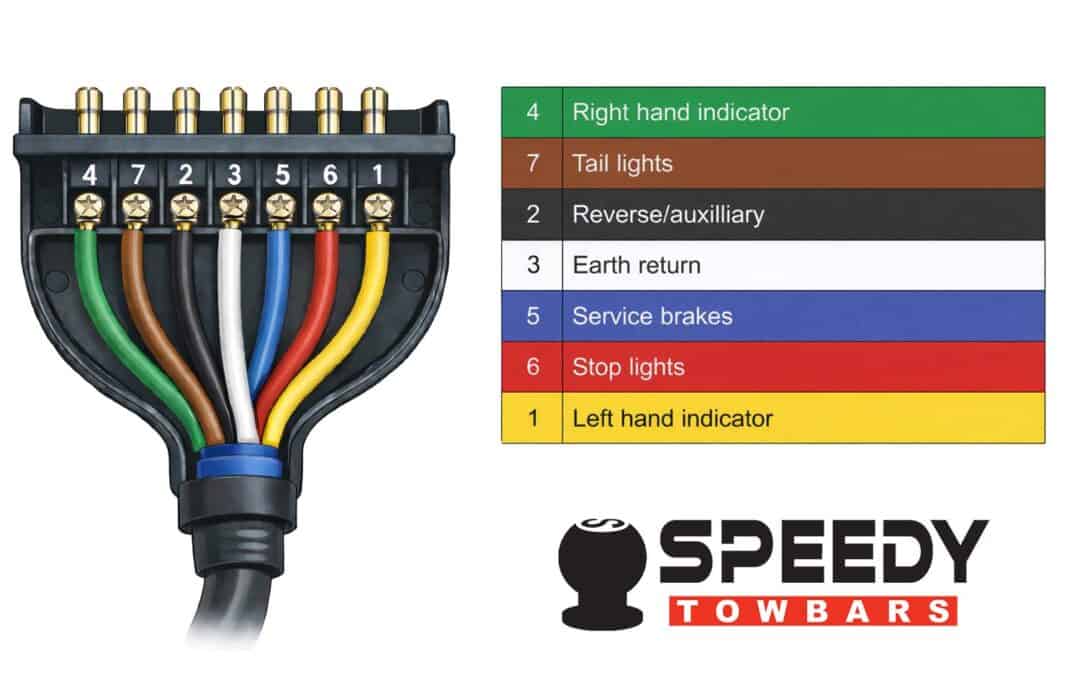
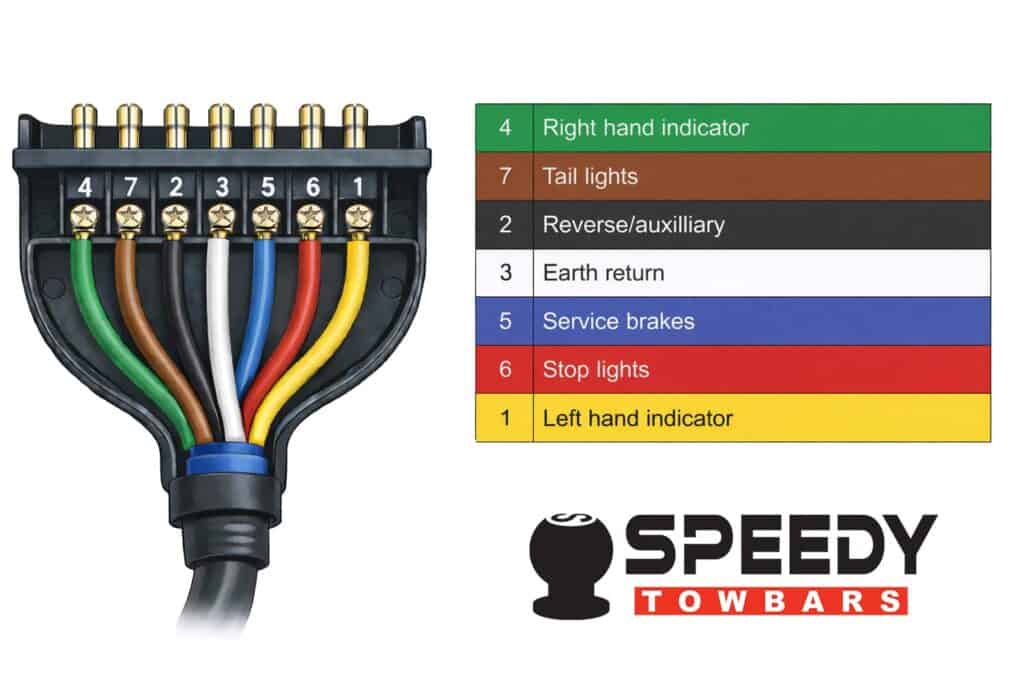
The image below shows how a 7-pin flat plug is typically wired.
The reverse or auxiliary pin is often left unconnected in standard installations because reverse lights on trailers are not a legal requirement.
In addition, if a breakaway charge wire is present in the trailer wiring, it can back-feed into the vehicle’s lighting circuits and cause issues. When required, this pin can instead be used for light-duty 12V auxiliary power, such as small charging or braking systems that do not require heavy cabling. This additional wiring is not included in a standard towbar installation and must be set up separately.
A correctly wired 7-pin plug is suitable for most light trailers and everyday towing needs. It’s wired like this:
What Is a 12 Pin Trailer Plug?
A 12-pin plug includes all the functions of a 7-pin plug, plus additional circuits for auxiliary power. These additional pins allow power to be supplied to accessories on the trailer or caravan.
Usually, not all 12 pins in the connector are used. The wiring configuration depends on how the trailer or caravan is set up. To correctly quote and install a 12-pin system, we require a wiring diagram or clear details of how your trailer’s plug is configured.
12-pin plugs are often fitted to caravans and many camper trailers because they provide the flexibility needed for modern touring setups. If your trailer has powered accessories, a 12-pin plug is usually required.
7 Pin and 12 Pin Plug Features
7 Pin Plug
- Standard setup suitable for most trailers
- Powers tail lights, brake lights and indicators
- Supports electric brakes when a brake controller is fitted to the vehicle
- Can optionally provide low current dedicated auxiliary power for batteries or other accessories
- Ideal for boat trailers, box trailers, horse floats, and smaller work trailers
12 Pin Plug
- Vehicle Connector accepts 7 Pin Trailer plugs
- Includes all 7-pin functions, plus additional power circuits
- Supports electric brakes when a brake controller is fitted to the vehicle
- Allows battery charging while driving (however, Anderson connectors are preferred)
- Can power fridges and internal trailer or caravan accessories
- Requires additional wiring on the vehicle and matching to the trailer
- Slightly higher cost, but significantly more capable
- Best suited to caravans, camper trailers, and powered work trailers
Can You Upgrade From 7-Pin to 12-pin?
Yes, upgrading from a 7-pin to a 12-pin plug is possible, but it is more involved than simply changing the socket at the back of the vehicle.
Additional wiring must be run from the vehicle battery or ignition to safely supply auxiliary power. If electric brakes are being added, an electric brake controller must also be installed and properly configured.
Do You Need an Isolator?
When fitting a 12-pin plug, auxiliary power circuits can be wired as constant power or through an isolator.
An isolator automatically cuts power when the vehicle is turned off or when battery voltage drops. This helps protect your vehicle’s starting battery from being drained while parked. Isolators are strongly recommended for caravans and trailers with fridges or battery charging systems.
Which Plug Is Right for You?
If you tow a standard trailer that only requires lights and possibly electric brakes, a 7-pin plug is usually all you need.
If you tow a caravan, camper trailer, or anything with onboard batteries or powered accessories, a 12-pin plug is often required.
If you are unsure, it is always best to ask before installation rather than guessing.
Contact Speedy Towbar
At Speedy Towbars, we believe in asking the right questions. When you book your installation, we look at your vehicle, what you tow, and your future plans.
We will recommend the correct trailer plug configuration and ensure your towbar and electrics are installed by fully qualified and experienced technicians.
You drive away ready to tow. Book your installation today.

Jordan is the co-owner of Speedy Towbars and a trusted source of towbar knowledge for Queensland drivers. When he's not installing towbars, he treasures time with his family and hitting the road for caravanning adventures!